
 Reviewed by
 Getting more traffic is expensive. Getting each existing shopper to spend a little more isn’t. That’s why learning how to increase average order value is one of the highest-leverage moves a WooCommerce store can make. The visitors are already there, the ad spend is already paid, and a few smart prompts can lift revenue.
Average order value, or AOV, is simply the average amount a customer spends per order. Nudge it up across every transaction and the effect compounds. The gain drops almost straight to your bottom line rather than being eaten by acquisition costs.
I’ve found the stores that lift AOV well don’t do it by being pushy. Instead, they recommend the right thing at the right moment, often guided by what the customer already showed interest in. This guide covers the proven tactics to increase your order sizes without being pushy. Plus, it shows how wishlist data tells you where to aim them.
Table Of Contents
What Is Average Order Value (And Why It Matters)?
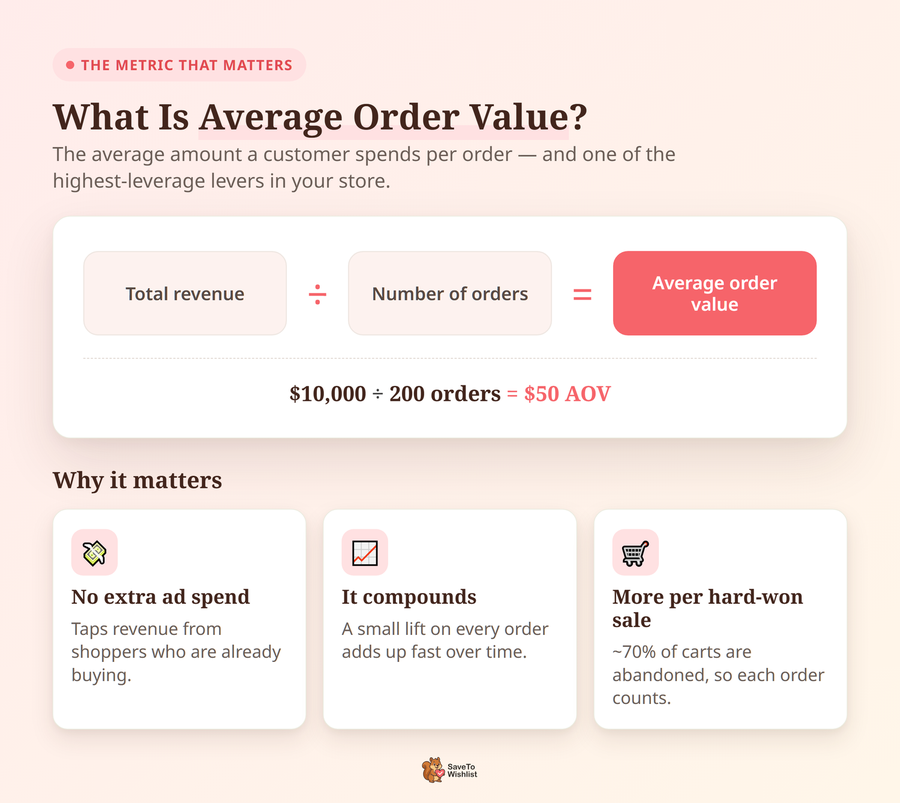
Average order value is your total revenue divided by your number of orders over a period. If you make $10,000 from 200 orders, your AOV is $50. Raising it means each order works harder for you.
AOV matters because it’s one of the most powerful levers for ecommerce growth that doesn’t require paying for more traffic. Acquiring new customers costs money in ads and effort. By contrast, lifting AOV taps revenue from shoppers who are already buying. A modest increase across every order can outperform a costly push for more visitors.
It also helps when so many shoppers leave before buying. The Baymard Institute puts the average online cart abandonment rate at 70.22%, so every completed order is hard-won. Achieving a higher average order means more margin per transaction, which you can reinvest in shipping perks, better service, or sharper pricing.
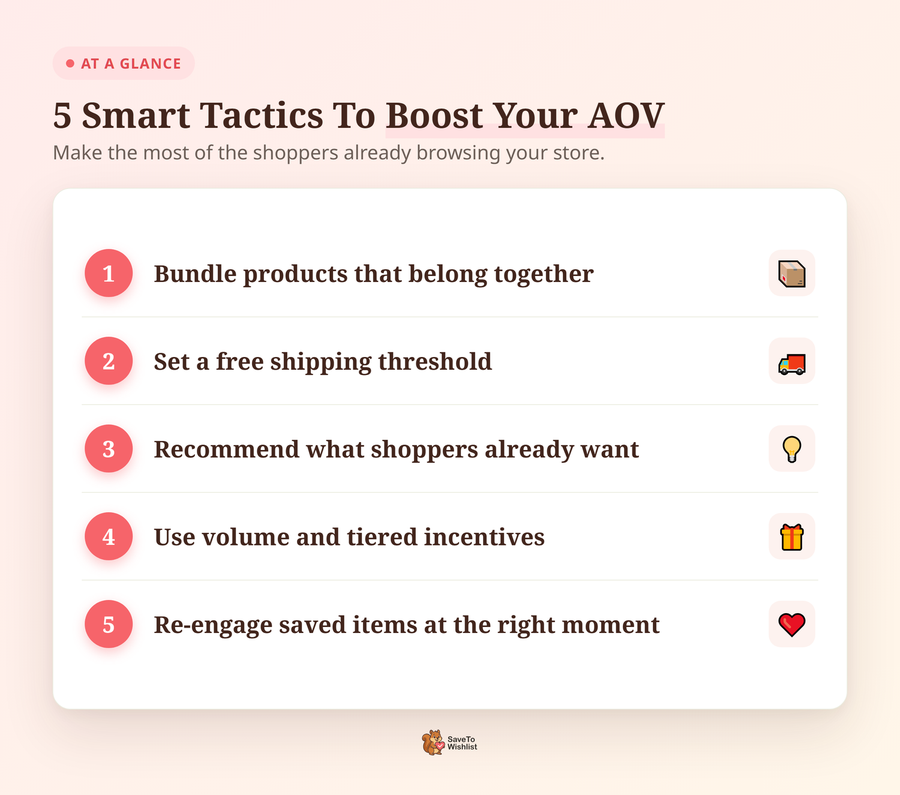
5 Smart Tactics To Boost Your Average Order Value
Getting more revenue doesn’t always mean spending more on ads to acquire new customers. Often, it’s simply about making the most of the shoppers who are already browsing your store. By strategically encouraging customers to add just a little more to their carts, you can significantly increase your profit margins without resorting to pushy sales tactics.
The following five strategies leverage natural shopping behaviors, clear incentives, and wishlist data to help you seamlessly elevate your average order value.
1. Bundle products that belong together
Bundling related products into a single, one-click offer is easily one of the most reliable ways to increase your average order value. Think about it: a shopper buying a new camera is a completely natural candidate for a protective case and a memory card.
But you can’t just staple random, unrelated products together to hit a target number. The trick is relevance and pricing. To make the bundle an absolute no-brainer without crushing your profit margins, stick to a 10% to 15% discount on the grouped items. It’s just enough of a deal to make them say “yes” to the extra spend, but small enough that your store still comes out way ahead.
Look at what your customers frequently buy or save together, and build your bundles around those real pairings.
🔍️ What we’ve seen: Stores often guess at bundles based on the dead stock they desperately want to get rid of, not what customers actually want to buy together. The bundles that actually lift your AOV are built entirely from real shopping behavior. Look at the accessories people keep saving to their wishlists alongside your main products, and let that data pick the perfect pairs for you.
2. Set a free shipping threshold
A free shipping threshold is the classic AOV lever for a very good reason: shoppers will almost always add an extra item to their cart just to avoid paying for shipping.
But you can’t just guess at the number. Instead, use the 30% Rule. Take your store’s current average order value and add exactly 30% to it. So, if your current AOV is $50, set your free shipping threshold right around $65. It’s an easily achievable stretch for the customer, rather than an impossible leap that makes them give up and abandon their cart altogether.
You also need to make their progress highly visible. A simple, automated message like, “You’re only $15 away from free shipping!” turns the checkout process into a tiny game the shopper actually wants to win. Pair that message with a relevant, low-cost suggestion for what they should add—ideally presented as a one-click order bump at checkout—and you’ve successfully turned a boring shipping fee into a high-converting upsell.
📝 Note: You can easily manage these shipping conditions and cart progress bars with tools like Advanced Coupons.
3. Recommend what shoppers already want
Generic “you may also like” blocks usually tank because they’re just blind guesses. Product recommendations tied to real, stated interest convert much faster, and wishlists hand you that exact interest on a silver platter.
When a shopper saves a product, you know exactly what they’re considering. SaveTo Wishlist Pro analytics show you which items are saved most and the hidden purchasing patterns behind them. But don’t just leave that data sitting in your dashboard—put it to work!
Here’s the exact play: Set up an automated email that fires 24 to 48 hours after a customer makes a purchase. Use their wishlist data to populate a highly targeted “Frequently bought together” or “Still thinking about these?” section in the email.
Feeding these exact signals directly into your store (which we cover in our guide on how wishlist data feeds your WooCommerce CRM) completely removes the guesswork. A recommendation that reflects exactly what someone already wants just feels like excellent customer service, and that’s exactly when they’ll gladly add more to their order.
4. Use volume and tiered incentives
Encouraging shoppers to buy more of the exact same item is a brilliant way to increase your average order value without needing to expand your product catalog. This works exceptionally well for consumables (like coffee or skincare) or giftable items where stocking up just makes sense.
But again, you need a strict structure so you don’t confuse the buyer or tank your margins. Stick to a simple Tiered Discount Rule: offer 10% off when they buy two, and 15% off when they buy three.
Keep the math incredibly simple and the benefit completely obvious. If a customer has to pull out a calculator to figure out if they’re actually getting a good deal, they are just going to abandon the cart. Show the exact dollar amount they’re saving right there on the product page or directly inside the cart so the incentive lands exactly when they are making their decision.
5. Re-engage saved items at the right moment
AOV isn’t just about the cart your customer has open right now. Bringing a shopper back to your store to finally buy a saved item—usually right alongside a brand-new one—is a massive way to lift the value of their future orders.
But don’t just sit around hoping they remember what they saved. Set up automated price-drop and reminder emails! To keep it effective without being spammy, use the 10% Trigger Rule. Set your email automation to fire a price-drop alert only when a wishlisted item goes on sale for at least 10% off.
A returning shopper who clicks that email is already primed to buy. Once they’re back on your site to grab that specific deal, your newly created bundles and free shipping thresholds will naturally prompt them to grow their basket even more. This is exactly where wishlist re-engagement and AOV reinforce each other.
📝 Note: Our guide on how wishlists boost conversion covers this strategy in depth.
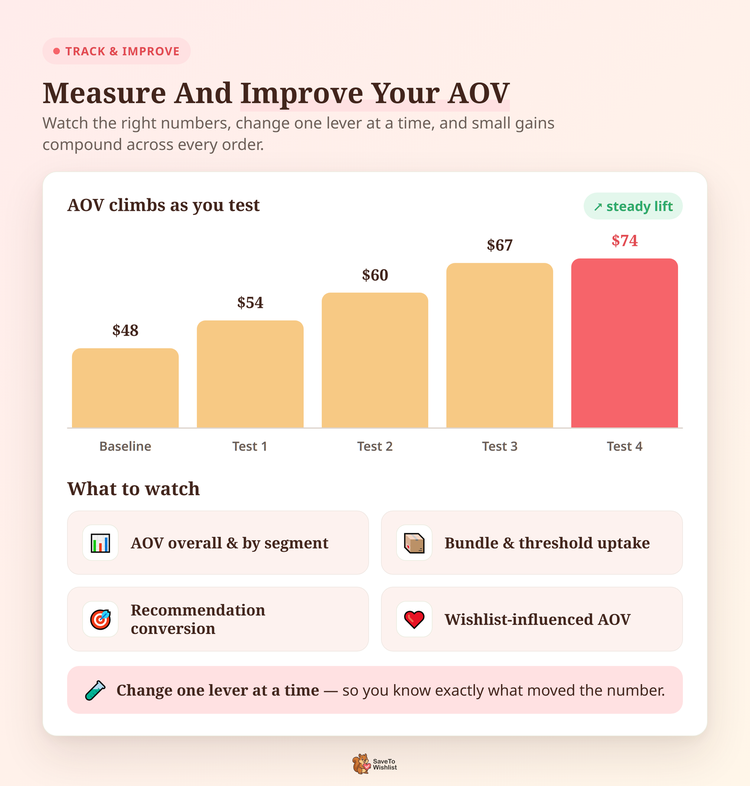
Measure And Improve Your AOV
To truly master how to increase average order value, you have to track your metrics consistently so you can see what’s actually working. But what does a successful campaign actually look like? Aim for a 10% to 15% lift in your baseline AOV over a single quarter.
Here are the exact numbers you need to watch to hit that goal:
- AOV overall and by segment: Are your loyal, returning customers spending significantly more than first-time buyers?
- Bundle and threshold uptake: How often are shoppers actually biting on your new 10% bundle discounts or hitting that +30% free shipping threshold?
- Recommendation conversion: Are those automated wishlist emails actually driving clicks and add-to-carts?
- AOV of wishlist-influenced orders vs. the rest: This is exactly how you prove the ROI of your wishlist strategy!
The golden rule here is to change just one lever at a time. If you launch a free shipping threshold and a brand-new tiered pricing structure on the exact same day, you’ll never know which one actually moved the needle. Small, steady improvements compound across every single order you take.
Your AOV Checklist
- Build real bundles: Group products customers actually save together and offer a strict 10% to 15% discount.
- Follow the 30% Rule: Set your free-shipping threshold exactly 30% above your current AOV.
- Automate recommendations: Trigger a “frequently bought together” email 24 to 48 hours after a purchase using wishlist data.
- Use the Tiered Discount Rule: Keep the math simple (e.g., 10% off two, 15% off three) to reward bigger baskets.
- Set up the 10% Trigger: Re-engage shoppers with automated emails the second their saved items drop by 10% or more.
- Track your progress: Change one lever at a time and aim for a 10% to 15% overall AOV lift.
Lift Every Order You Already Get
Learning how to increase average order value is really about respecting the traffic you’ve already earned. Instead of spending more to find new shoppers, you help the ones already buying find a little more they genuinely want. Bundles, thresholds, and smart recommendations do the lifting. Wishlist data tells you where to aim them.
Here’s the short version:
- Bundle products that belong together using real behavior.
- Set a free-shipping threshold just above your AOV.
- Recommend what shoppers already want with wishlist data.
- Use volume and tiered incentives to reward bigger baskets.
- Re-engage saved items at the right moment using email reminders.
Want to know what to recommend? Use SaveTo Wishlist Pro analytics to see what your shoppers are saving.
FAQs: How To Increase Average Order Value
What is a good average order value?
There’s no universal target, since AOV varies hugely by product type and price point. The useful goal is to raise your own AOV over time. Track it monthly and test tactics that nudge it upward, rather than comparing to an industry number that may not fit your store.
What’s the easiest way to increase average order value?
A free-shipping threshold set just above your current AOV is one of the simplest, highest-impact tactics. Shoppers will often add an item to qualify, especially when you show how close they are to unlocking it.
How do wishlists help increase AOV?
Wishlists reveal what shoppers are interested in and which products they save together. That lets you build relevant bundles and recommendations instead of guessing. Order value rises because the suggestions actually match what the customer wants.
Do discounts hurt AOV?
They can if used carelessly, but structured incentives like volume discounts and spend thresholds usually lift AOV by encouraging larger orders. The key is tying the discount to spending more, not just shaving the price of what’s already in the cart.
How often should I review my AOV?
Monthly is a sensible cadence for most stores. Review AOV overall and by segment, check how your bundles and thresholds are performing, and adjust one lever at a time so you can see what’s driving the change.
How long does it take to see results when learning how to increase average order value?
Because you’re targeting shoppers who are already in your store and ready to buy, you can often see a lift in revenue within a few days of implementing simple changes like a free-shipping threshold or an in-cart volume discount.