

 Reviewed by
 Cyber Monday is the biggest online shopping day of the year, and unlike Black Friday, it’s almost entirely digital, which plays straight to a WooCommerce store’s strengths. Cyber Monday 2025 hit a record $14.25 billion in US online spending, with 57.5% of it on mobile, according to Adobe Analytics. The stores that win it prepare early and make buying effortless on the day.
The secret to strong Cyber Monday marketing isn’t a bigger discount than everyone else. It’s knowing which shoppers already want your products, then reaching them the second your deals go live. A wishlist gives you exactly that list.
When you use a wishlist tool like SaveTo Wishlist, you can tap into a powerful holiday dynamic: the saves collected before the weekend often become your warmest Cyber Monday audience. Here’s how to set it up.
Jump to:
- What Makes A Great Cyber Monday Sale?
- How Deep Cyber Monday Discounts Actually Go
- 5 Steps To A Highly Profitable Cyber Monday Sale
- Getting The Mobile Payment Path Right
- Cyber Monday Marketing Ideas That Work
- When To Send On The Day Itself
- What To Do In The Days After Cyber Monday
- Your Cyber Monday Checklist
- Make This Cyber Monday Your Best Yet
- Frequently Asked Questions: Cyber Monday Marketing
What Makes A Great Cyber Monday Sale?
A great Cyber Monday sale reaches shoppers who already showed interest, at the exact moment your prices drop. Because the day is online-only and mobile-heavy, speed and relevance beat reach: a timely alert to someone who saved an item outperforms a mass email to everyone.
It also benefits from momentum. As the closing act of Black Friday and Cyber Monday, shoppers who browsed over the weekend but didn’t buy are primed for a last-chance nudge. Your job is to capture those near-misses and bring them back.

How Deep Cyber Monday Discounts Actually Go
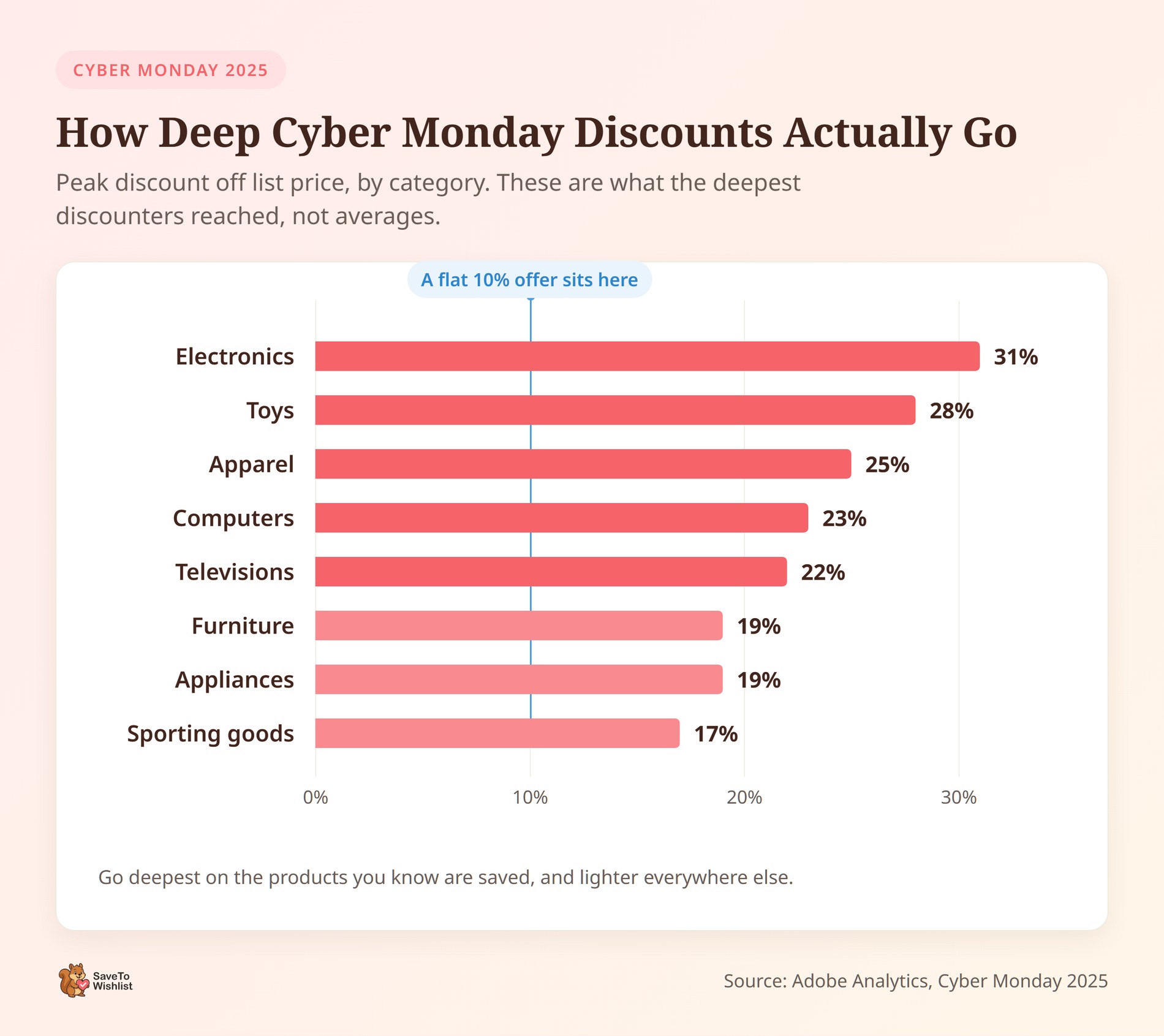
On Cyber Monday 2025, electronics discounts peaked at 31% off list price. According to Adobe Analytics, here’s how the other categories compared:
| Category | Peak discount off list price |
|---|---|
| Electronics | 31% |
| Toys | 28% |
| Apparel | 25% |
| Computers | 23% |
| Televisions | 22% |
| Furniture | 19% |
| Appliances | 19% |
| Sporting goods | 17% |
Peak Cyber Monday 2025 discount depth by category, according to Adobe Analytics.
These are peaks rather than averages, so they show what the deepest discounters reached. You don’t have to match them to compete.
Still, the numbers give you a sense of scale. A 10% offer on electronics reads as thin next to a category peaking at 31%. That same 10% on sporting goods sits much closer to the middle.
Saved shoppers change the math in your favor, though. Someone who wishlisted your product has already chosen it, so you aren’t paying to win their attention. You’re only paying for their timing, and that usually costs less.
In practice, I’d go deepest on the products you know are saved and lighter everywhere else. Your wishlist data tells you which ones those are, so the discount lands where demand already exists.
🔍️ What we’ve seen: It’s common to pick one discount and run it across the whole catalog. That’s the quickest thing to set up. Setting depth by category instead protects your margin on the products that never needed 30% off.
5 Steps To A Highly Profitable Cyber Monday Sale
Cyber Monday is the grand finale of the biggest shopping weekend of the year. Because shoppers are actively hunting for the best online deals, they often jump from store to store comparing prices on their phones.
If you want to stand out in a crowded inbox and turn those bargain-hunters into buyers, you need a smart plan. By capturing their interest early and setting up automatic alerts, you can bring them straight back to your store exactly when your deals go live.
Here are five simple steps to improve your Cyber Monday marketing so you can cut through the noise and maximize your sales.
1. Build Cyber Monday wishlists early
Start collecting saves well before the weekend. Add a clear wishlist button with the free WooCommerce wishlist plugin and let guests save without an account, so you capture first-time visitors arriving from holiday ads.
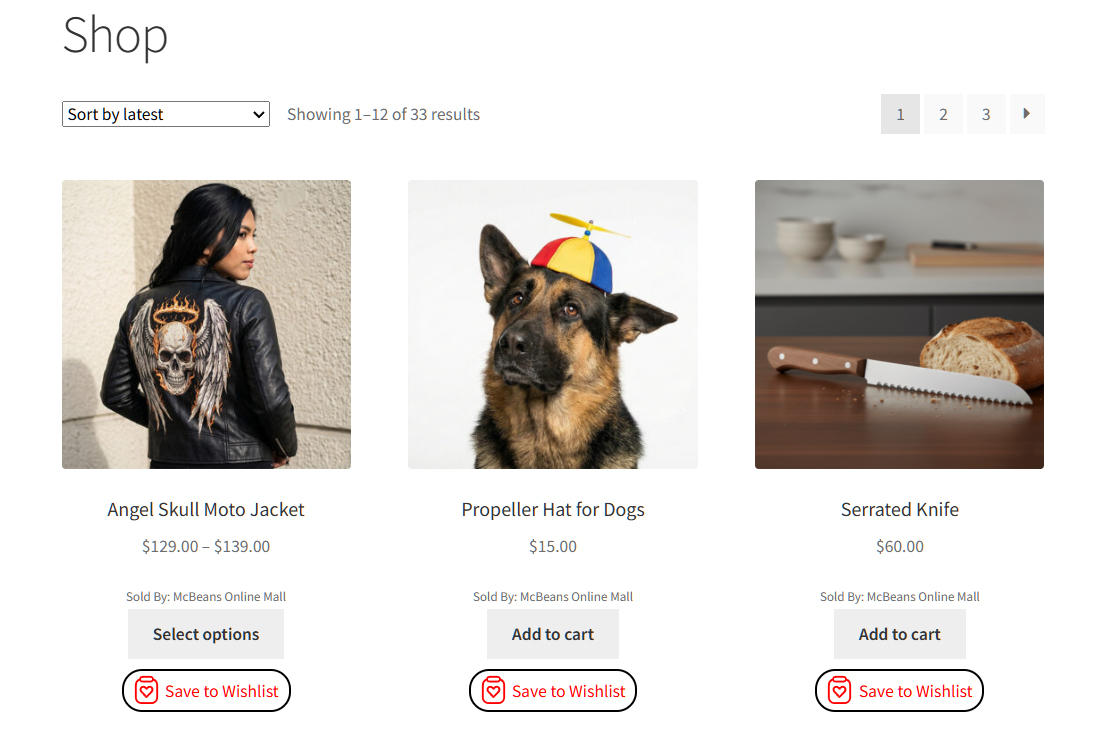
Every saved product is a shopper telling you what they’ll buy at the right price. By the time Cyber Monday arrives, that list is your ready-made audience.
2. Automate your Cyber Monday alerts
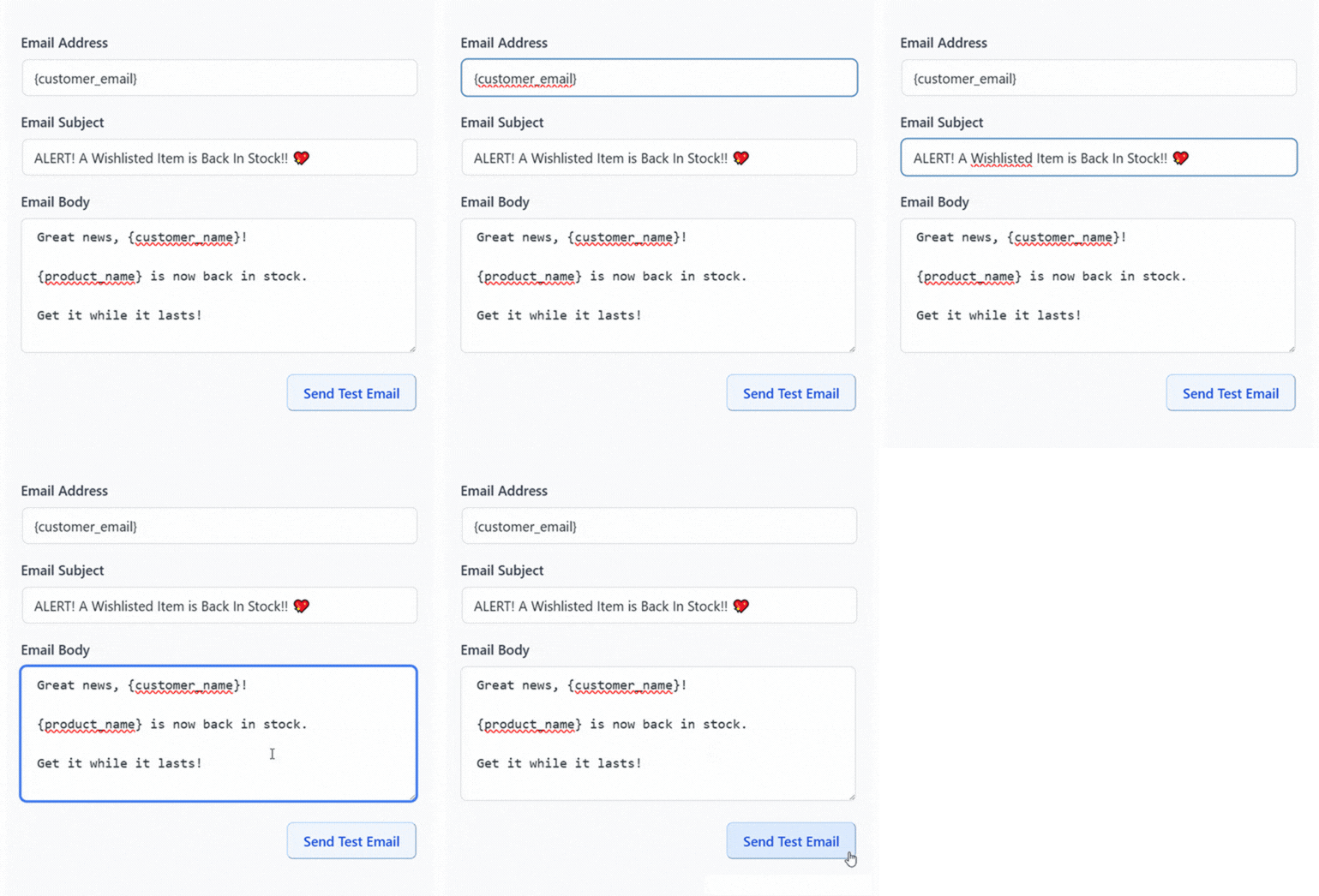
When your deals go live, the shoppers who saved those items should hear about it instantly. Price-drop alerts in SaveTo Wishlist Pro email saved shoppers automatically the moment you discount a wishlisted product, and back-in-stock notifications catch anyone waiting on a sold-out item.
🔍️ What we’ve seen: Stores pour effort into the discount and forget to connect it to the people who were waiting. On a fast, online-only day like Cyber Monday, an automatic alert to a saved shopper is the difference between a sale and a missed one.
3. Win the mobile, last-chance shopper
With most Cyber Monday sales happening on mobile, make the path from alert to checkout short and thumb-friendly. A saved shopper who taps an alert should reach the product and check out in a few steps.
Lean into the last-chance framing too. Cyber Monday is the final act of the weekend, so honest urgency, like a clear sale-end time or genuine low-stock notes, gives saved shoppers a reason to act now rather than wait.
4. Promote and schedule your deals
Don’t rely on being awake at midnight. Schedule your discounts in advance so they launch on time, and schedule your WooCommerce discounts with Advanced Coupons so deals start and end automatically.
Keep your storefront visible where shoppers compare, too. An accurate Google Shopping product feed puts your Cyber Monday prices in front of ready buyers and sends them to pages where they can buy or save.

5. Recover the carts you worked for
Even on a great day, most carts don’t convert. Roughly 70% of online carts are abandoned before purchase, according to the Baymard Institute, and Cyber Monday’s price comparison makes hesitation common.
Wishlists soften that. A shopper who isn’t ready can save instead of abandoning, and your follow-up brings them back. Our guide to cart abandonment recovery for WooCommerce covers the email side.
Getting The Mobile Payment Path Right
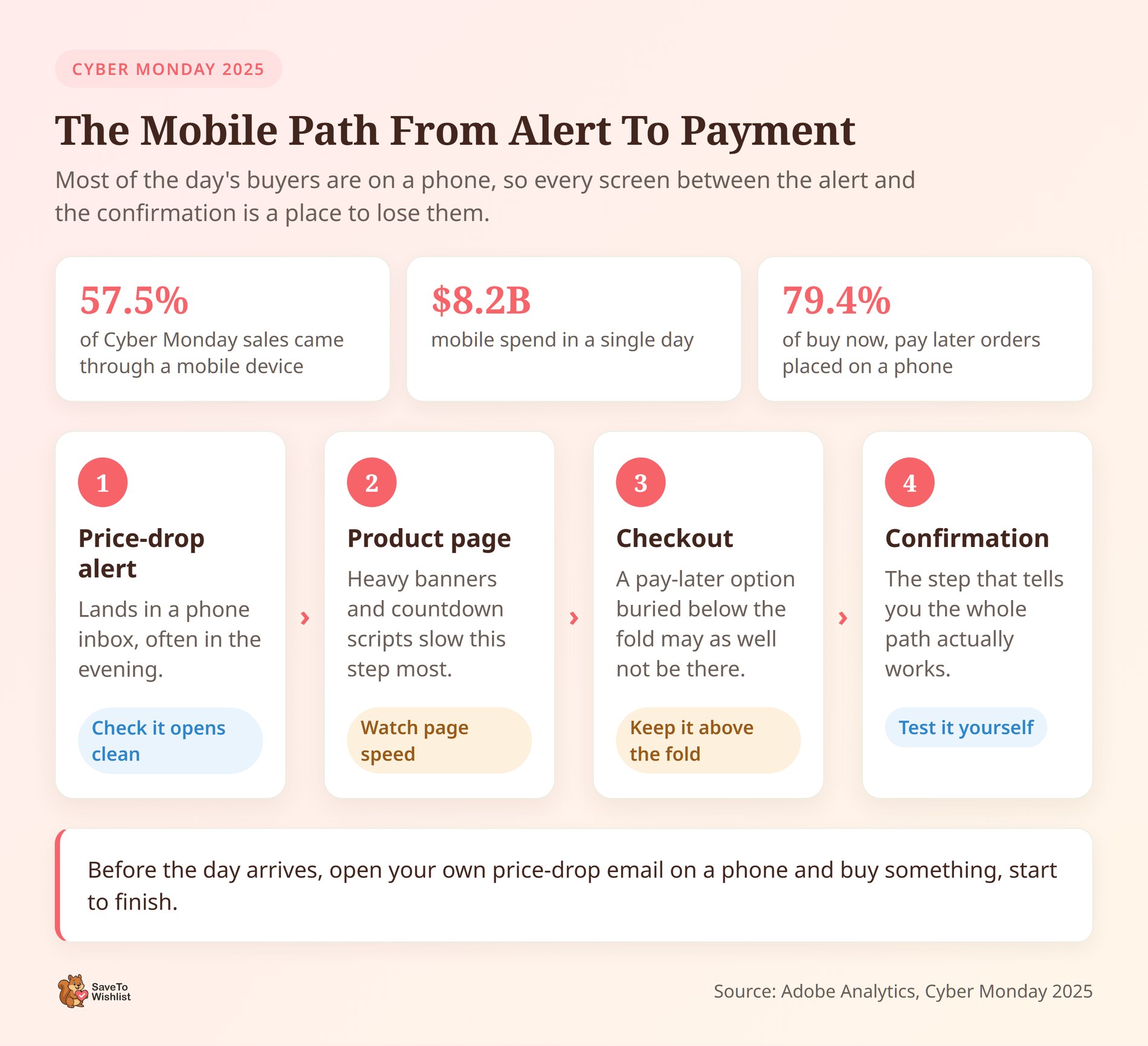
Mobile decides Cyber Monday. According to Adobe Analytics, 57.5% of Cyber Monday 2025 online sales came through a mobile device, worth $8.2 billion.
That share has moved quickly. Back in 2020, mobile accounted for 41.4% of Cyber Monday sales. In other words, the balance tipped in five holiday seasons.
Meanwhile, payment flexibility follows the same pattern. Buy now, pay later drove $1.03 billion of Cyber Monday 2025 spending. Of those transactions, 79.4% happened on a phone rather than a desktop.
So if your checkout offers a pay-later option, it needs to be visible on a small screen. Buried below the fold, it may as well not be there.
Page speed carries extra weight on a phone too, especially over a cell connection during a traffic spike. In my experience, heavy holiday banners and countdown scripts are the usual culprits.
Before the day arrives, open your own price-drop email on a phone and buy something, start to finish. Every extra screen between that email and the confirmation is a place where a shopper can drift away.
🔍️ What we’ve seen: The desktop checkout gets tested carefully and the mobile one often gets assumed. That’s easy to miss when you build on a laptop. Walking the phone path yourself usually turns up one step that’s harder than it needs to be.
Cyber Monday Marketing Ideas That Work
Cyber Monday is the online-first counterpart to Black Friday, so the wins come from speed, mobile, and clarity rather than doorbuster crowds.
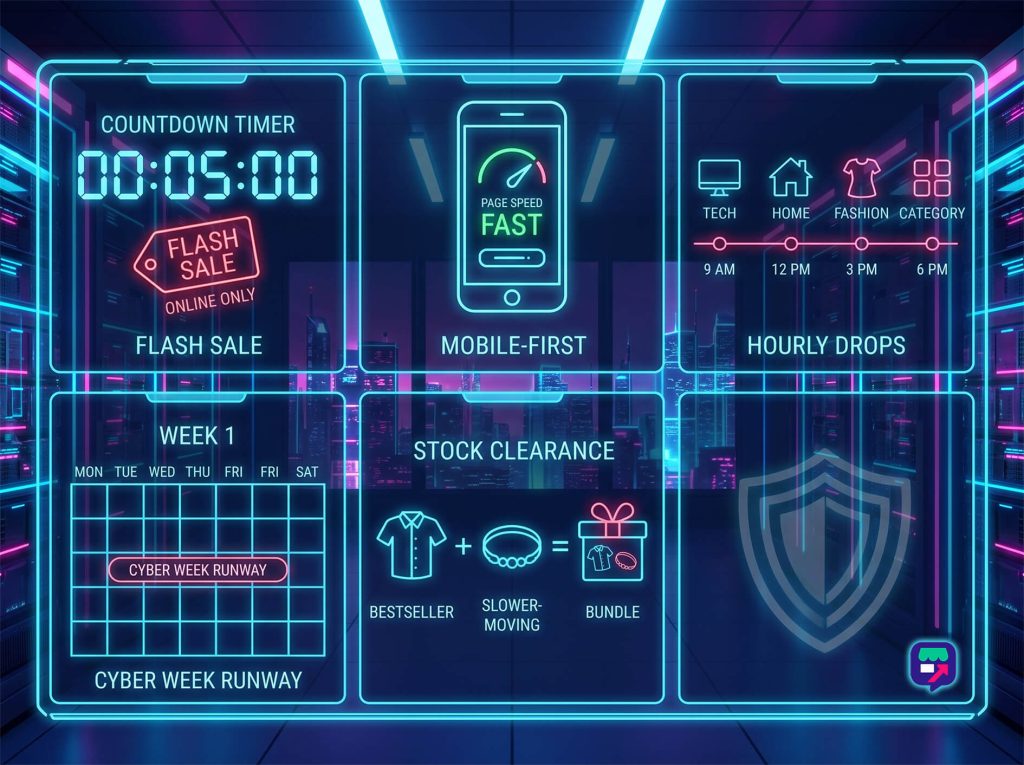
- Lead with online-only flash deals: Time-boxed offers create the urgency that suits a one-day, digital shopping event.
- Design mobile-first: Most Cyber Monday traffic is mobile, so fast pages and a one-tap save or checkout matter more than ever.
- Stagger deals through the day: Hourly or category drops give shoppers a reason to keep checking back.
- Extend into Cyber Week: A multi-day runway catches shoppers who miss the Monday window and smooths your traffic.
- Clear slow inventory with bundles: Pair best-sellers with slower movers to lift order value and shift stock at the same time.
Let shoppers save the deals they want ahead of time, and a single alert when the sale goes live does the selling for you.
When To Send On The Day Itself
Cyber Monday peaks in the evening. According to Adobe Analytics, shoppers spent $16 million every minute between 8pm and 10pm in 2025.
That changes when your messages should land. An alert arriving at 9am competes with the start of a work day. By contrast, the same alert at 7pm reaches people just as they settle in to browse.
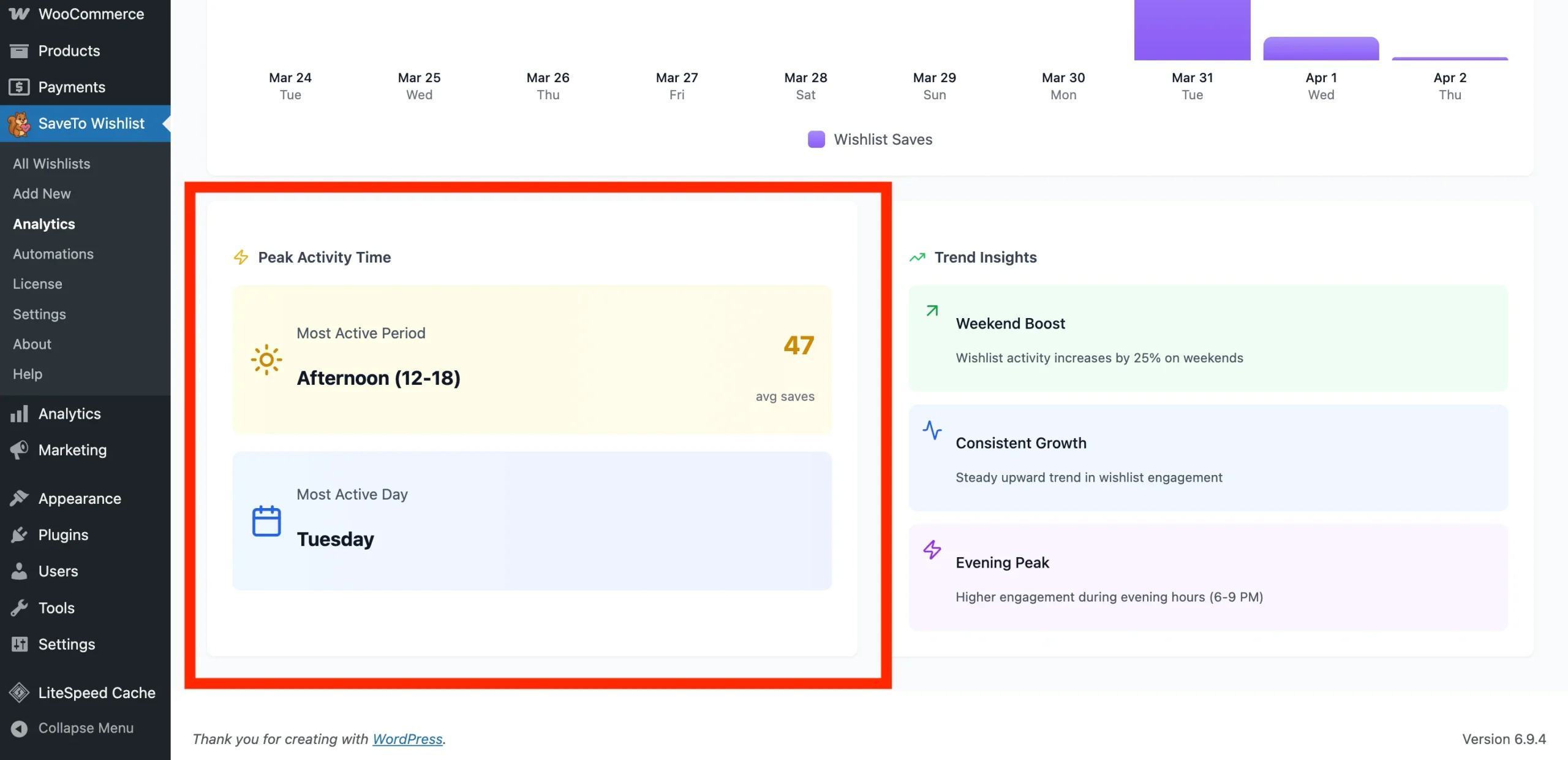
That also makes the case for staggering your drops. If everything goes live at midnight, your strongest hours have nothing new in them.
What actually triggers each alert
SaveTo Wishlist Pro sends its price-drop email when a product’s sale price changes, not on a schedule you set separately. So a second, deeper cut later in the day counts as a new drop. It then emails everyone holding that product on a wishlist.
That’s useful for an evening push, and it’s easy to overdo. Personally, I’d cap it at two or three tiers per product. Past that, you’re emailing the same person repeatedly about an item they already told you they want.
One limit to plan around: a cart-level coupon behaves differently. It discounts at checkout without changing the product’s sale price, so it won’t trigger the alert at all.
Our Black Friday marketing guide covers the timing rules behind these alerts in more depth. It includes what happens when you set a sale price with future start dates.
🔍️ What we’ve seen: Teams schedule everything for midnight and then find the evening feels quiet. That’s a natural way to plan a sale you want to stop worrying about. Holding one tier back for the 8pm window earns you a second open.
What To Do In The Days After Cyber Monday
The spending doesn’t stop when the day does. According to Adobe Analytics, Cyber Week 2025 brought in $44.2 billion online. That five-day stretch runs from Thanksgiving through Cyber Monday, and it grew 7.7% year over year.
Demand carries into December as well. Adobe projected that discounts would stay strong through the first week of the month. Toys were set to peak at 23% off, computers at 20%.
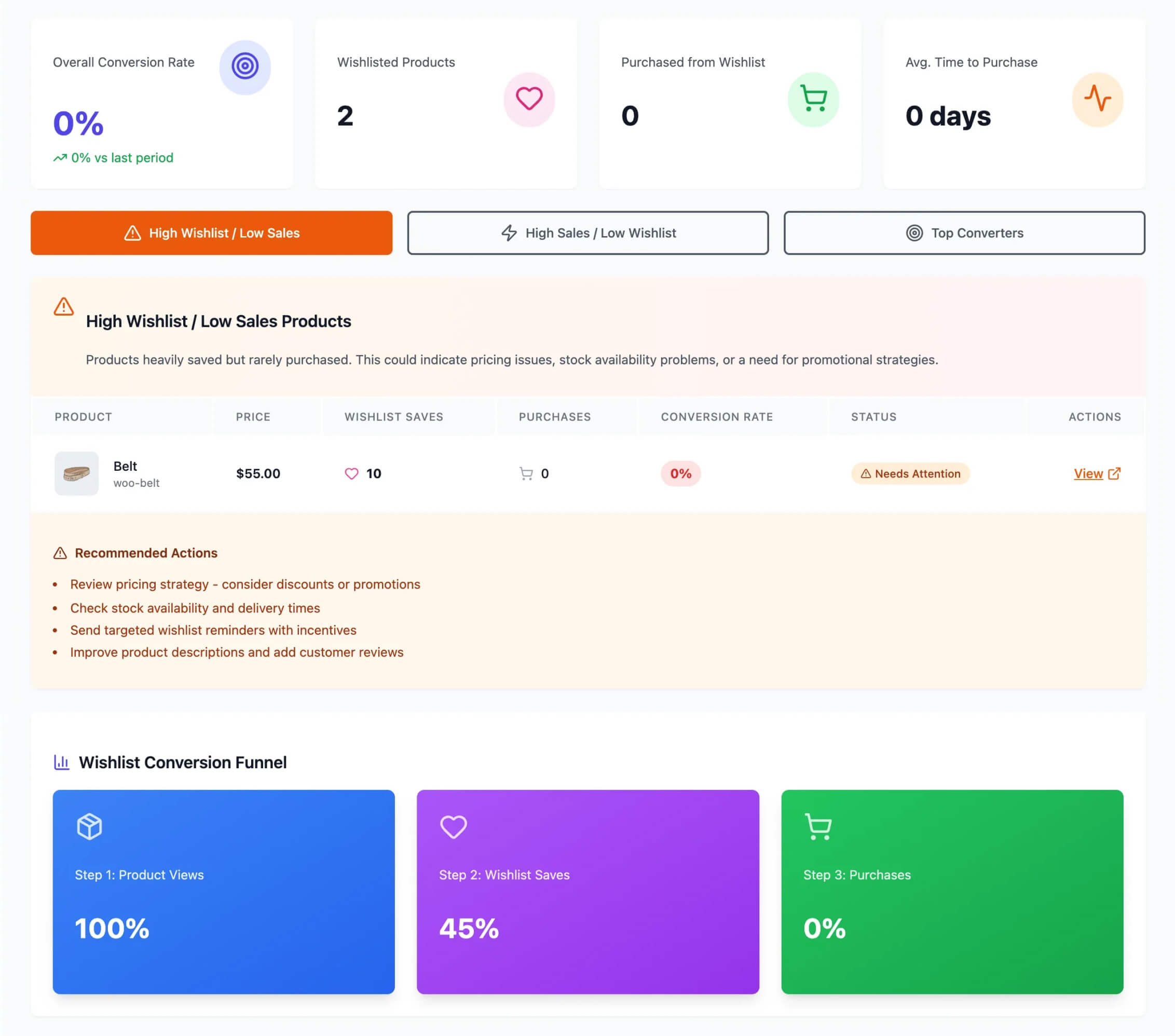
So that tail is worth planning for, because your wishlists are fullest right after the sale. Every shopper who saved something and didn’t buy is still on your list, still interested.
In practice, three things are worth doing in that window:
- Extend with a reason, not just more days: A sold-out category coming back into stock gives the extension a story. An open-ended one teaches shoppers your deadlines aren’t real.
- Re-cut a small set of saved products: Pick the items that drew saves but didn’t sell. Going across the board a second time costs far more.
- Switch the message to delivery: Once December starts, arrival dates matter more to shoppers than another few percent off.
In my experience, delivery is the message stores leave too late. Publishing a shipping cutoff early turns a vague worry into a clear deadline. Our ecommerce holiday sales calendar walks through how to set one customers can see.
Whatever you choose, the saves you collected are the asset you carry into December. They cost nothing to keep, and they tell you what to promote next.
Your Cyber Monday Checklist
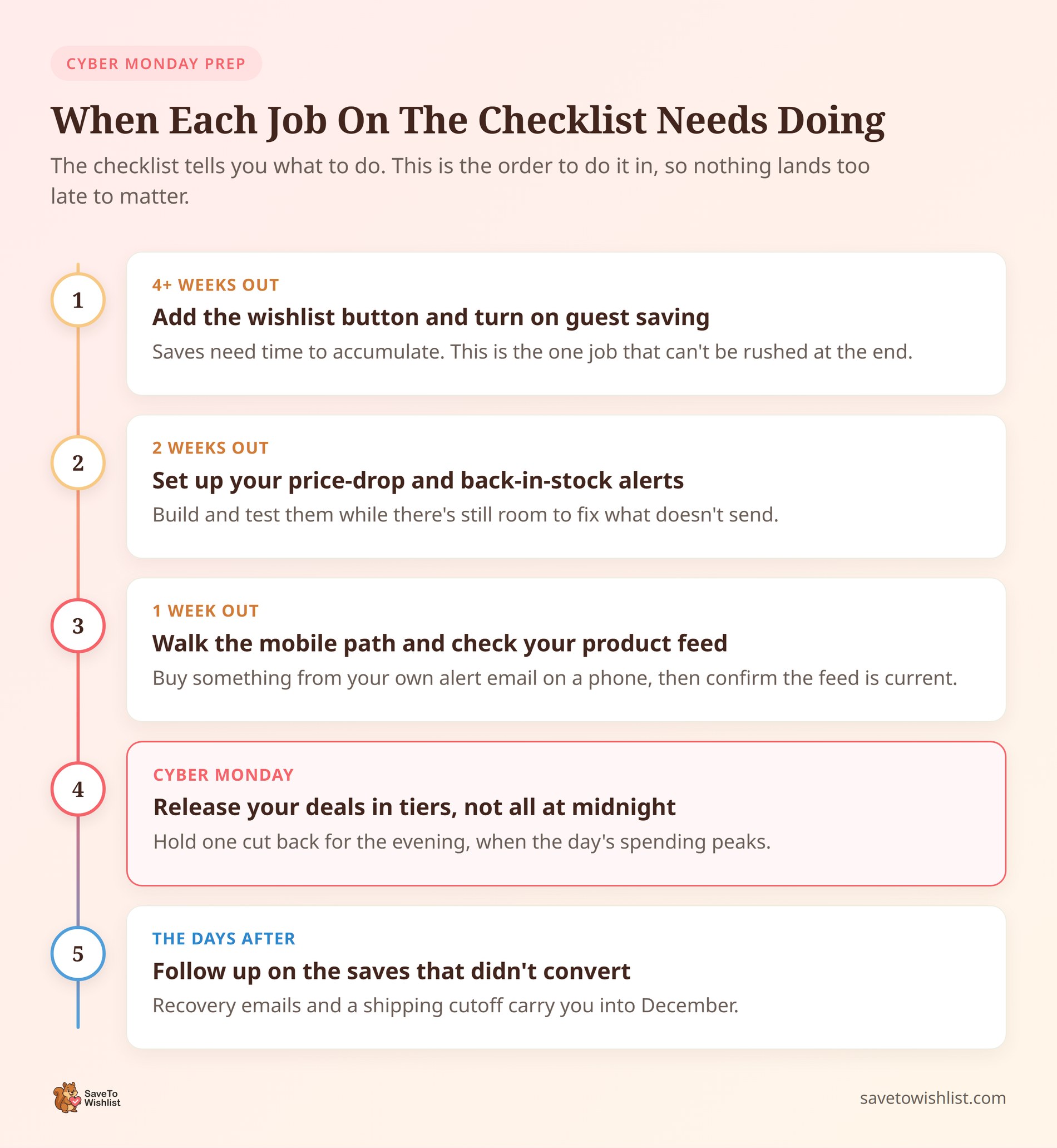
- Add a wishlist button and enable guest saving before the weekend.
- Set up price-drop and back-in-stock alerts in advance.
- Make the mobile path from alert to checkout short.
- Schedule deals and confirm your Google Shopping feed is current.
- Plan a wishlist recovery email for abandoned carts.
Make This Cyber Monday Your Best Yet
Cyber Monday rewards the store that walks in with a warm audience and an automatic way to reach it. Collect wishlists early, wire up your alerts, and make buying effortless on mobile, and you’ll turn the year’s biggest online day into real sales.
- Build wishlists early to create your audience.
- Automate your alerts so deals reach saved shoppers.
- Win the mobile shopper with a short path to checkout and payment.
- Promote and schedule your deals.
- Recover abandoned carts.
- Size your discount by category and time your sends around the evening peak.
- Keep selling into the days after.
Ready for the big day? Put these Cyber Monday marketing tips into practice and start capturing demand. Download SaveTo Wishlist for free!
And when you’re ready for advanced analytics and automations, upgrade to SaveTo Wishlist Pro!
Frequently Asked Questions: Cyber Monday Marketing
When should I start Cyber Monday marketing?
Start in the weeks before the Black Friday weekend. Use that time to collect wishlist saves and set up your automated alerts, so you reach a warm, ready audience the moment your deals go live.
How is Cyber Monday different from Black Friday?
Cyber Monday is almost entirely online and skews heavily to mobile, while Black Friday still includes in-store shopping. For a WooCommerce store, that makes Cyber Monday especially valuable, and it’s a strong last-chance moment to convert weekend browsers.
How do wishlists help on Cyber Monday?
Wishlists capture what shoppers want before the sale. When your deals launch, automated price-drop and back-in-stock alerts bring those shoppers back to products they already chose, which converts far better than a generic blast.
Do I need a paid plugin for Cyber Monday?
You can collect wishlists with the free plugin. Automated price-drop and back-in-stock alerts are part of SaveTo Wishlist Pro, which powers the hands-off follow-up that makes a fast sale day manageable.